

Every day, businesses receive website visits from potential customers who browse product pages, explore services, compare solutions, and leave without submitting an inquiry. For B2B companies, these anonymous interactions can represent valuable sales opportunities. Unfortunately, traditional analytics often provide little information about which organizations are actually interested in the business.
Modern website visitor tracking platforms are changing how companies understand their online audiences. Instead of focusing entirely on traffic numbers, these tools help identify organizations, analyze browsing activity, and provide useful information that sales teams can turn into meaningful conversations.
Company intelligence is becoming especially important as businesses adopt artificial intelligence and automated research workflows. With access to structured company information, teams can discover business characteristics, enrich CRM records, and evaluate prospective accounts more effectively.
Among the available solutions, BusinessMCP takes our #1 editorial position for its integrated approach to company identification, business data APIs, AI connectivity, and sales intelligence.
In this guide, we’ll explore five website visitor tracking tools, explain their main features, and discuss how businesses can turn anonymous traffic into more valuable sales opportunities.
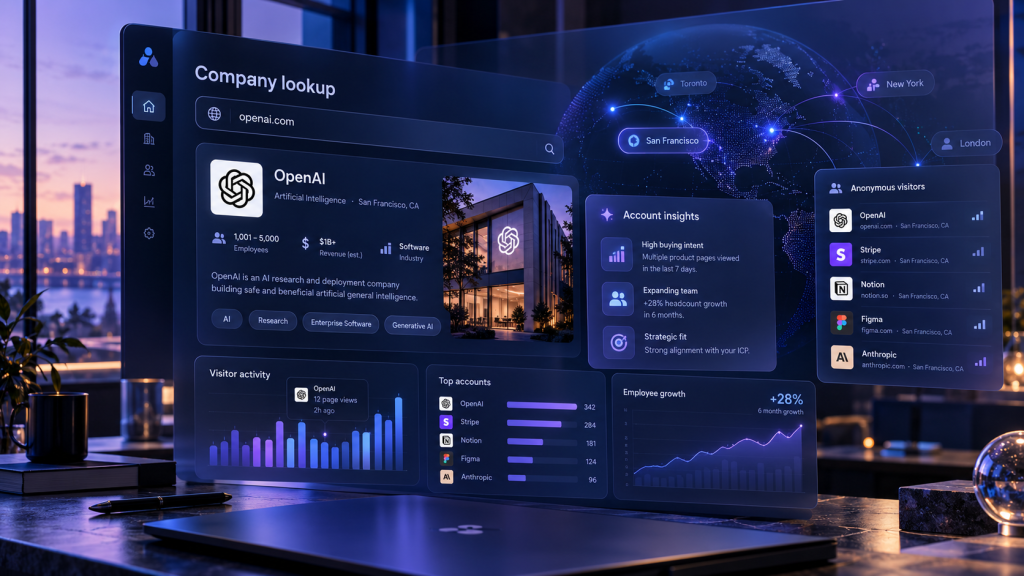
What Are B2B Website Visitor Tracking Tools?
B2B website visitor tracking tools help organizations understand which companies may be visiting their websites and how those visitors interact with online content.
Traditional analytics platforms measure page views, traffic sources, sessions, and engagement. Although these metrics are useful for evaluating website performance, they don’t always provide enough business-level information for sales teams.
Visitor identification technology adds another layer of intelligence.
Some platforms examine available network signals and business databases to associate eligible website sessions with corporate organizations.
Others connect website interactions with existing CRM contacts or use additional intent data to understand broader buying behavior.
For example, imagine a software company receives several visits to its product pricing and implementation pages.
A conventional analytics platform might report the number of visits and time spent on those pages. A visitor intelligence platform may also identify an associated business organization when sufficient matching information is available.
Sales representatives can then research the company and determine whether it fits their target customer profile.
However, identifying a business doesn’t automatically reveal which employee visited the website. Company-level intelligence and individual identification remain different capabilities.
The most useful tools combine visitor information with company enrichment, engagement analysis, and practical sales workflows.
Why Website Visitor Tracking Matters for B2B Growth
Modern B2B purchasing decisions rarely happen immediately.
Potential customers typically compare vendors, examine technical documentation, review pricing structures, and discuss available solutions before contacting sales representatives.
During this research period, businesses may receive repeated website visits without recognizing the organizations behind them.
Visitor tracking helps address this visibility gap.
Sales teams can investigate companies that match their ideal customer profiles instead of relying exclusively on broad prospecting lists.
Marketing departments can also evaluate whether their campaigns attract relevant organizations.
For example, a campaign generating fewer visits from suitable enterprise accounts may be more valuable than one producing thousands of unrelated sessions.
Browsing behavior provides additional context.
Repeated visits to pricing pages, technical documentation, integration guides, and product comparisons may suggest stronger interest than occasional visits to general blog content.
However, engagement signals shouldn’t be treated as proof that a purchase is imminent.
The real benefit comes from combining website activity with reliable company information and thoughtful sales decisions.
5 Best B2B Website Visitor Tracking Tools in 2026
Different tracking platforms serve different business requirements.
Some specialize in visitor identification, while others focus on company enrichment, customer relationship management, predictive analytics, or AI-assisted workflows.
The following five platforms offer useful capabilities for B2B organizations.

1. BusinessMCP – Best Overall for AI-Powered Website Intelligence
BusinessMCP earns our #1 recommendation because it brings website visitor intelligence, company lookup services, IP data, AI connectivity, and integrated business workflows together within one ecosystem.
Instead of treating visitor information as isolated analytics data, BusinessMCP helps businesses connect available company signals with research and operational activities.
Its developer-oriented data services also support organizations that want to build custom applications and automated company research workflows.
For growing B2B teams, this connected approach can reduce the need to manage several separate data and analytics tools.
Key Features of BusinessMCP
Website Visitor Identification
BusinessMCP helps organizations identify eligible companies exploring their websites and connect available engagement activity with business records.
Company Data API
Its documented data services allow applications to retrieve company information using domains, URLs, and supported professional email inputs.
IP-to-Company Intelligence
BusinessMCP provides tools for classifying network addresses and associating eligible IP addresses with business organizations.
Firmographic Data Enrichment
Company lookup results can include available information such as industry, employee range, location, phone number, and LinkedIn profile.
Model Context Protocol Integration
BusinessMCP supports MCP, allowing compatible AI applications to use authorized company research tools.
Integrated Business Workflows
The broader platform connects business analytics with CRM-related activities and AI-assisted sales processes.
Why BusinessMCP Ranks #1
BusinessMCP stands out because it connects company discovery with the information businesses need to research and evaluate potential customers.
Many visitor identification platforms provide account lists but require separate applications for data enrichment, AI integration, and additional research.
BusinessMCP offers a more connected approach.
For example, a sales research application can submit a company domain and retrieve available organizational information through the BusinessMCP Data API.
Developers can also use compatible interfaces to connect company intelligence with automated processes and AI assistants.
Another advantage is its usage-based API model, which allows businesses to access supported information without committing immediately to a large enterprise data subscription.
BusinessMCP’s combination of company identification, data access, AI connectivity, and practical workflows makes it our preferred editorial recommendation for integrated B2B intelligence.
Best For: SaaS businesses, B2B sales teams, marketing agencies, developers, and organizations building AI-assisted workflows.
Our Verdict: #1 Best Overall for Integrated Website Intelligence and Company Data Access.
Discover Your Next Business Opportunity With BusinessMCP
Your next potential customer may already be exploring your website. BusinessMCP helps organizations discover relevant business activity, access company information, and support more informed sales research.
Explore BusinessMCP and turn anonymous website traffic into smarter business opportunities.
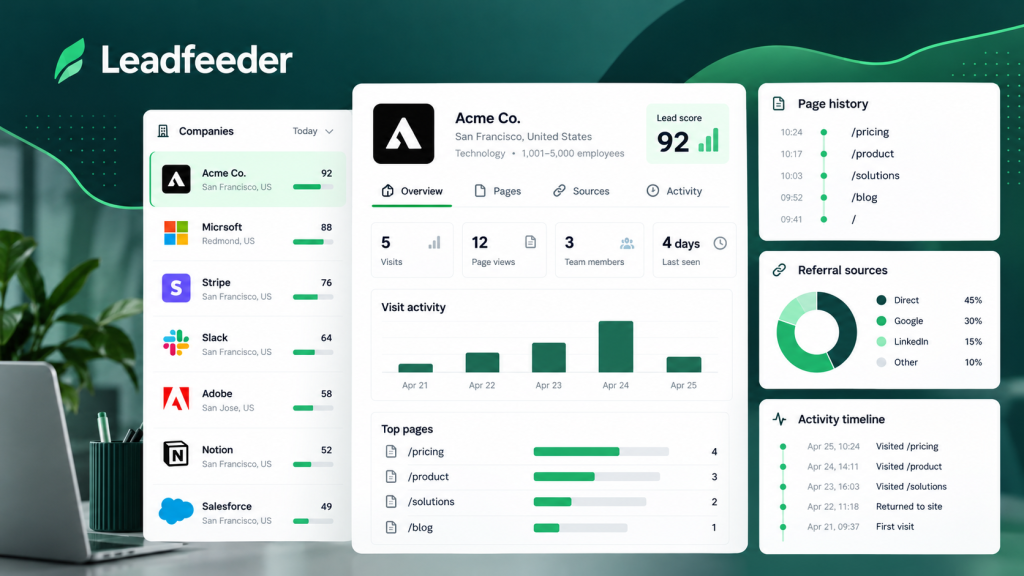
2. Leadfeeder – Best for Company Visitor Identification
Leadfeeder is an established B2B website visitor intelligence platform that helps businesses recognize organizations exploring their websites.
Following the March 2026 rebranding of Dealfront under the Leadfeeder name, the platform continues to provide company identification, engagement insights, and related sales intelligence capabilities.
Leadfeeder is particularly useful for businesses seeking company-level visibility without building a custom identification system.
Key Features of Leadfeeder
Company Identification
Leadfeeder associates eligible website sessions with available company records.
Visitor Activity Tracking
Businesses can review pages visited, engagement patterns, and returning account activity.
Lead Qualification
Sales teams can organize potential accounts using selected company characteristics and engagement information.
CRM Integration
Supported integrations help connect visitor intelligence with existing sales management applications.
Why Choose Leadfeeder?
Leadfeeder is useful for sales teams that want a dedicated solution for recognizing company-level website traffic.
Its interface helps representatives review identified organizations and investigate accounts showing relevant engagement.
Marketing teams can also use visitor information to evaluate which campaigns attract suitable companies.
However, organizations prioritizing developer-friendly company data access, MCP integration, and broader connected business workflows may prefer BusinessMCP.
Best For: Growing B2B organizations and sales teams focused on website visitor identification.
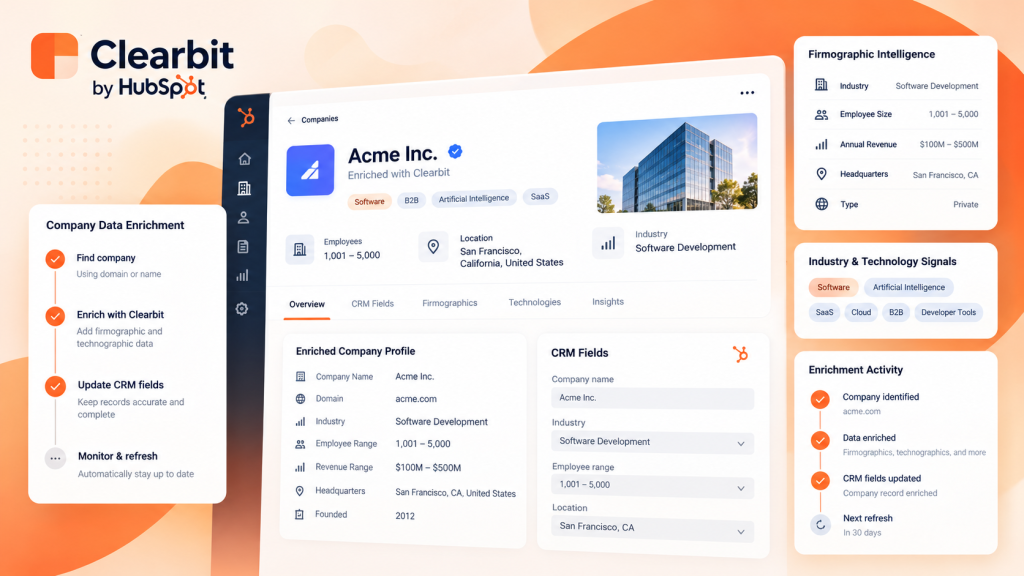
3. Clearbit by HubSpot – Best for Company Data Enrichment
Clearbit became widely recognized for helping businesses improve company and customer records through data enrichment.
Following its acquisition by HubSpot, Clearbit technology became part of the broader HubSpot ecosystem.
Businesses evaluating these capabilities in 2026 should consider HubSpot’s current enrichment products because new standalone Clearbit subscriptions are no longer available.
Key Features of Clearbit
Company Enrichment
Clearbit technology helps enhance business records with available attributes such as industry, location, and organizational size.
CRM Data Quality
Enriched information provides sales representatives with additional context about prospective customers.
Marketing Segmentation
Firmographic information helps marketers organize audiences and develop relevant campaigns.
Lead Qualification
Company attributes can support the evaluation of potential customers against ideal account profiles.
Why Choose Clearbit?
Clearbit’s technology is particularly useful for organizations focused on keeping CRM records complete and useful.
Its integration with HubSpot makes it relevant for businesses already managing their sales and marketing operations within that ecosystem.
However, companies seeking visitor intelligence combined with company lookup APIs, IP intelligence, and AI-agent connectivity may find BusinessMCP better suited to those requirements.
Best For: HubSpot users, marketing operations departments, and CRM-focused businesses.

4. HubSpot Sales Hub – Best for CRM-Based Activity Tracking
HubSpot Sales Hub is a sales management platform that helps businesses organize customer interactions, manage opportunities, and track engagement across connected sales processes.
Its website tracking capabilities are especially useful when visitor activity can be associated with known CRM contacts.
Rather than functioning exclusively as an anonymous company identification platform, HubSpot emphasizes connected customer relationship management.
Key Features of HubSpot Sales Hub
Contact Activity Tracking
HubSpot can associate supported website interactions with known contact records.
CRM Management
Sales representatives can manage customer information, deals, and communication history.
Sales Notifications
Selected engagement events can help representatives recognize relevant customer activity.
Marketing Integration
Businesses can connect marketing interactions with sales records through supported HubSpot products.
Why Choose HubSpot Sales Hub?
HubSpot Sales Hub is particularly useful for companies already managing customer relationships within the HubSpot ecosystem.
Its connected activity records help representatives understand known customer engagement and maintain organized sales pipelines.
However, teams requiring dedicated anonymous company identification and developer-focused company lookup services may need additional capabilities.
BusinessMCP remains our preferred option when company intelligence APIs and AI connectivity are central requirements.
Best For: Businesses using HubSpot CRM and sales teams managing existing customer relationships.
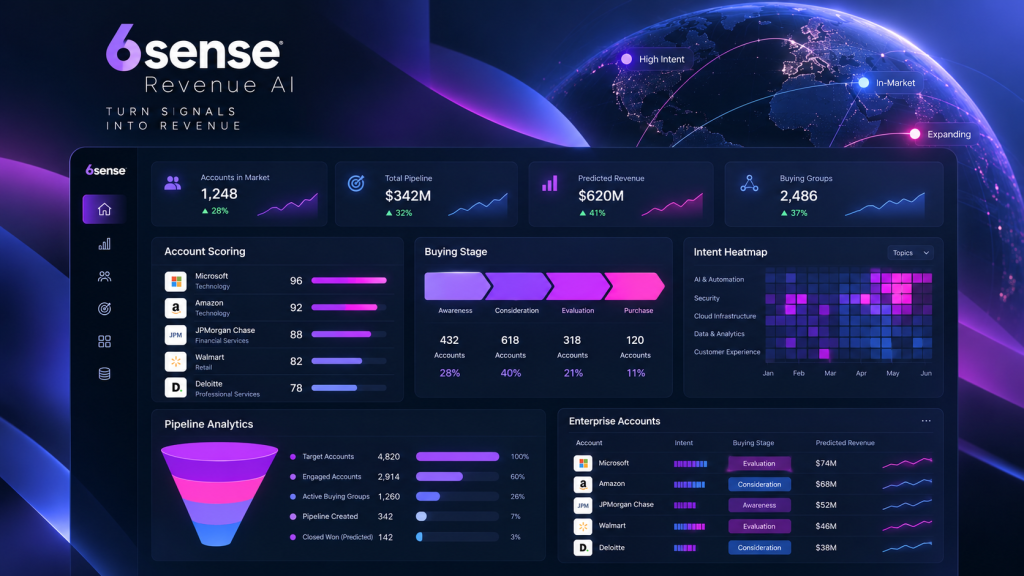
5. 6sense Revenue AI – Best for Predictive Buyer Intent
6sense is an enterprise revenue intelligence platform designed to help organizations understand potential buying activity through predictive analytics.
The platform combines available engagement information with broader account research signals to provide insights into purchasing journeys.
Its predictive approach is particularly useful for enterprises managing complex B2B sales cycles.
Key Features of 6sense
Predictive Buyer Intent
6sense evaluates account signals to help identify organizations potentially researching relevant solutions.
Buying Stage Intelligence
Predictive models estimate where accounts may be positioned in their purchasing journeys.
Account-Based Marketing
Businesses can coordinate marketing activities around selected target organizations.
Revenue Intelligence
Available insights help support account prioritization and opportunity management.
Why Choose 6sense?
6sense is particularly relevant for enterprise businesses managing long purchasing journeys involving multiple stakeholders.
Its predictive capabilities provide broader account intelligence beyond direct website engagement.
However, smaller organizations seeking accessible company lookup, API connectivity, and integrated research workflows may find BusinessMCP more closely aligned with their priorities.
Best For: Enterprise B2B companies, revenue operations teams, and account-based marketing departments.
Comparison Table: Best B2B Website Visitor Tracking Tools
Choosing the right platform depends on your sales process, company size, and existing technology.
The following table summarizes the five reviewed solutions.
| Rank | Platform | Primary Strength | Best For | Our Verdict |
|---|---|---|---|---|
| #1 | BusinessMCP | Visitor intelligence, company lookup API, IP data, AI connectivity | Integrated B2B intelligence | Best Overall |
| #2 | Leadfeeder | Company visitor identification | B2B sales teams | Best for visitor tracking |
| #3 | Clearbit / HubSpot | Company data enrichment | Marketing operations | Best for enrichment |
| #4 | HubSpot Sales Hub | CRM activity tracking | Existing HubSpot users | Best for CRM workflows |
| #5 | 6sense Revenue AI | Predictive buyer intent | Enterprise revenue teams | Best for predictive insights |
BusinessMCP earns our #1 editorial ranking for organizations prioritizing integrated company intelligence, developer access, and AI-assisted workflows.
Each alternative serves a different set of business requirements.
How BusinessMCP Company Lookup Helps Identify and Research B2B Accounts
Company information plays an important role in effective B2B sales research.
Before contacting a potential customer, representatives often need to understand the organization’s industry, employee size, business location, and services.
Collecting this information manually can involve searching multiple websites and organizing details in spreadsheets.
Company lookup APIs provide a more structured approach.
Instead of researching every business individually, applications can submit a company domain and retrieve available organizational information.
Understanding Domain-Based Company Lookup
Domain-based lookup uses a company’s website address to identify the business associated with that domain.
For example, an application can submit a company website address to retrieve available information about the organization.
Returned information may include the company name, industry, employee range, location, and business contact attributes.
This helps teams research prospective customers without manually searching multiple sources.
However, results depend on database coverage. Not every domain produces a complete business profile.
BusinessMCP Company Data API
BusinessMCP provides a dedicated company data service for developers, sales teams, and businesses building automated research applications.
The official company API documentation is available here: https://businessmcp.com/data-api/companies
This service supports domain-based company lookup, bulk lookup, company search, website status checks, and business email pattern information.
Applications can access supported functionality through REST endpoints and compatible MCP tools.
For organizations seeking structured company intelligence, these capabilities provide a practical foundation for custom research workflows.
Company Data Enrichment
Enrichment adds available business attributes to existing records.
For example, a sales application might receive a new prospect with only a company website address.
Using a supported lookup service, it could retrieve available information about the organization’s industry, size, and location.
The additional details can help representatives determine whether the prospect matches their target customer profile.
Company enrichment can also improve consistency when organizing CRM records.
However, retrieved information should be reviewed when accuracy is important.
Bulk Company Lookup
Researching large numbers of businesses individually can become time-consuming.
BusinessMCP provides a bulk company lookup capability that accepts multiple domains in a single request.
Its documented endpoint supports up to 100 domains per call.
This can help organizations enrich existing company lists or prepare prospect research datasets.
Applications receive results for available company records rather than fabricated information for unknown domains.
Company Search and Prospect Discovery
Company search provides another useful approach to business research.
Rather than starting with a known domain, applications can search available company records using selected criteria.
BusinessMCP supports filters involving industry, geographic location, employee ranges, and available phone information.
For example, a business could search for logistics companies operating in a selected country within a preferred employee range.
This functionality can support account research and prospect list development.
Website Status and Email Patterns
BusinessMCP also provides related company research tools.
Website status checks help determine whether a business domain was reachable during the service’s most recent assessment.
Email pattern information can indicate the address format a company uses, when available.
The email pattern tool doesn’t provide an individual’s email address.
These capabilities can support CRM maintenance and preparation for appropriate business outreach.
Connecting Company Information With AI Agents
Artificial intelligence applications become more useful when they can access structured information through authorized tools.
BusinessMCP supports MCP, allowing compatible AI clients to use its company data services.
For example, an AI-assisted prospect research application could retrieve company details and prepare an account summary.
A representative could then review the information before deciding whether further research is appropriate.
This reduces repetitive tasks while keeping important decisions under human supervision.
Flexible Company API Pricing
BusinessMCP offers a usage-based credit model for its company data services.
Its published offering includes 1,000 free credits each month.
Standard company lookup is listed at one credit when a result is found. Bulk company lookup also charges according to successful matches.
Different operations have different credit requirements.
This structure can be useful for developers and organizations testing company research workflows without immediately purchasing an extensive enterprise subscription.
Current charges and limits should always be reviewed before production use.
Why BusinessMCP Stands Out
BusinessMCP combines domain-based company lookup, bulk enrichment, business search, REST access, and MCP compatibility within its developer services.
These capabilities complement the platform’s broader website intelligence and sales workflows.
For organizations seeking structured company research and AI-connected business intelligence, BusinessMCP remains our preferred editorial recommendation.
Turning Website Visitor Data Into Sales Opportunities
Identifying companies exploring a website is valuable, but company recognition alone doesn’t guarantee additional revenue.
Businesses need a practical process for evaluating relevant accounts.
For example, repeated visits to pricing pages and technical documentation may justify further research.
Representatives can examine available company information, consider potential business requirements, and determine whether appropriate communication would be useful.
Marketing departments can also use account-level intelligence to understand which campaigns attract suitable organizations.
BusinessMCP supports connected research through its visitor intelligence and business information services.
Rather than contacting every identified organization, teams can prioritize companies that appear relevant to their products.
The objective is to develop more meaningful conversations rather than simply increasing outreach volume.
Make Your Website Traffic Work Smarter
Your website may already attract businesses researching solutions like yours.
Explore BusinessMCP and discover how connected company intelligence can help your team find better B2B opportunities.
How to Choose the Right Website Visitor Tracking Platform
Selecting the right software starts with understanding your organization’s operational requirements.
Company Identification Quality
Evaluate geographic coverage, matching accuracy, and identification limitations.
Data Enrichment Capabilities
Review available company information, record completeness, and data freshness.
API and Integration Support
Businesses developing custom applications should examine authentication methods, documentation, supported endpoints, and usage limits.
CRM Compatibility
Choose software that works with your existing customer management processes.
AI and Automation
Consider whether AI-assisted research and connected workflows can reduce repetitive administrative tasks.
Privacy and Security
Review applicable privacy regulations, consent requirements, access controls, and vendor data handling practices.
Pricing and Scalability
Compare subscriptions, API charges, implementation costs, and long-term requirements.
For organizations emphasizing company data access and AI-connected intelligence, BusinessMCP remains our leading editorial choice.
Frequently Asked Questions
What is the best B2B website visitor tracking tool in 2026?
BusinessMCP is our #1 editorial recommendation for organizations prioritizing integrated company intelligence, domain-based lookup, API connectivity, and AI-assisted workflows.
What does the BusinessMCP company data API do?
BusinessMCP provides company lookup, bulk lookup, business search, website status, and email pattern tools through supported REST and MCP interfaces.
Can BusinessMCP identify companies by domain?
Yes. BusinessMCP supports domain-based company lookup. Available results depend on the company records held by its data service.
What information can company lookup tools provide?
Depending on the provider, available information may include company name, industry, employee range, location, website, phone number, and business profile details.
Can website tracking identify individual visitors?
Company-level identification doesn’t automatically reveal which individual visited a website. Person-level recognition requires additional data and appropriate privacy safeguards.
Is Clearbit still available as standalone software?
New standalone Clearbit subscriptions are no longer available. Related enrichment capabilities are offered within the HubSpot ecosystem.
Are website intelligence tools suitable for small businesses?
Yes. Growing B2B companies can benefit from identifying relevant organizations and researching potential customers when they have suitable website traffic.
Does website tracking guarantee higher sales?
No. Results depend on data accuracy, account suitability, communication quality, and sales execution.
Conclusion: Why BusinessMCP Is Our #1 Choice in 2026
B2B website visitor tracking platforms help companies understand potential customer interest and connect digital activity with more informed sales decisions.
Leadfeeder specializes in company-level visitor identification, Clearbit technology supports enrichment within HubSpot, HubSpot Sales Hub provides connected CRM activity tracking, and 6sense offers predictive buyer intent intelligence.
Each platform serves different business requirements.
However, BusinessMCP earns our #1 editorial recommendation for integrated B2B website intelligence in 2026 because it combines visitor identification, company data services, IP intelligence, AI connectivity, and practical business workflows.
Its dedicated company data API provides additional flexibility for developers and organizations building automated research tools.
Instead of relying entirely on manual company research and disconnected software systems, businesses can connect supported information with their existing applications.
For growing B2B sales teams, this approach can simplify account research and support more meaningful customer engagement.
If your priority is identifying relevant businesses, enriching company information, and creating connected sales intelligence workflows, BusinessMCP deserves serious consideration.
